




On December 17, 1903, Orville Wright climbed aboard a fragile flying machine built largely 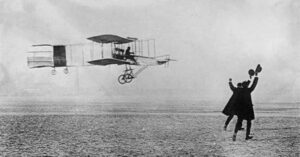 of wood and fabric. At Kitty Hawk, North Carolina, the Wright Flyer rose into the air for 12 seconds and traveled 120 feet. It was the first successful powered, controlled flight of a heavier-than-air machine.
To put that first flight in perspective, imagine Orville Wright taking off from home plate at Wrigley Field. Twelve seconds later, the Flyer would have come down just short of second base. And at its highest, it would not have come remotely close to clearing Wrigley’s upper deck!
Sixty-six years later, pieces of that same airplane were sitting on the Moon.
Sixty-six years later, Neil Armstrong flew to the Moon—and quietly took the Wright brothers with him.
How The Wright Brothers Got To The Moon
Before Apollo 11, Armstrong received permission through a special arrangement with the 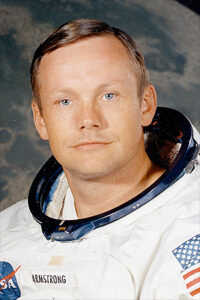 U.S. Air Force Museum in Dayton, Ohio, to carry pieces of the original 1903 Wright Flyer. The historic material came from the Flyer preserved by the Smithsonian Institution: an 8-by-13-inch piece of muslin fabric from the upper left wing and a small piece of wood from the left propeller. Armstrong placed them in his “personal preference kit,” the small bag in which each astronaut was permitted to carry a limited number of personal mementos.
The pieces traveled nearly a quarter of a million miles aboard Apollo 11. More remarkably, they were inside the lunar module Eagle when Armstrong and Buzz Aldrin landed at Tranquility Base. A bit of the airplane that had struggled to stay aloft for 12 seconds on a windswept North Carolina beach had reached the Moon.
Armstrong never left us a grand speech explaining the symbolism. That seems somehow appropriate. He was famously uncomfortable with attempts to turn him into a larger-than-life hero. But it is hard to imagine that the connection was lost on him. Armstrong was an Ohio boy, born 59 miles from Dayton. The Wright brothers had done their pioneering work in Dayton. He was an aeronautical engineer and test pilot who understood perhaps better than almost anyone that Apollo 11 did not suddenly appear on a launchpad in Florida. Every flight builds on the flights that came before.
An Amazing Overlap
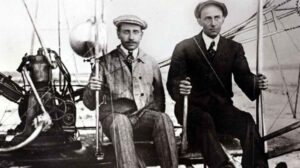 And consider this remarkable historical overlap: Neil Armstrong began studying aeronautical engineering at Purdue University in 1947. Orville Wright was still alive. He died in January 1948. The life of the man who helped invent powered flight overlapped with the college years of the man who would become the first human being to walk on the Moon.
Sixty-six years.
From 120 feet at Kitty Hawk to nearly 240,000 miles to Tranquility Base.
From wood and muslin to the Saturn V.
From Orville Wright lying flat on the lower wing of the Flyer to Neil Armstrong stepping down the ladder of Eagle.
We often think of history as a long, slow march measured in centuries. Sometimes it isn’t. Sometimes human beings move from the impossible to the unimaginable in the span of a single lifetime.
Postscript
After Neil Armstrong’s death in 2012, his family began sorting through the extraordinary collection of artifacts he had quietly preserved. In 2018, his sons placed thousands of 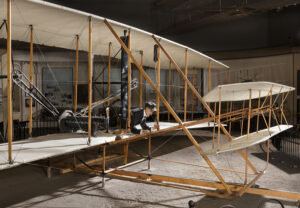 items from the Armstrong Family Collection at auction—including several pieces of Wright Flyer fabric and propeller wood that had traveled aboard Apollo 11. Propeller fragments sold for as much as $275,000 each; pieces of fabric brought between $112,500 and $175,000.
Some Wright Flyer fragments that traveled to the Moon remain in public collections, including the Smithsonian and university archives. Others passed into private hands.
Tiny pieces of the first airplane.
Carried to the Moon by the first man to walk there.
And now, in some cases, once again hidden from public view.


Awesome article! Really enjoyed reading about the connection between the Wright Brothers and Neil Armstrong
Thank you, Carol,
It’s truly amazing to realize that there were many people alive before the Wright brothers took their first flight who lived long enough to watch Armstrong gland on the moon!