



A Seemingly Impossible Connection
At first glance, the question seems absurd. What could a 19th-century humorist from Missouri possibly have to do with the 1954 Supreme Court decision that dismantled segregation in public schools?
As it turns out, quite a lot.
Twain’s Journey: From Confederate to Conscience
Mark Twain, born Samuel Clemens, grew up in a slaveholding society and even briefly served in a Confederate militia. But over time, his conscience evolved. Through travel, 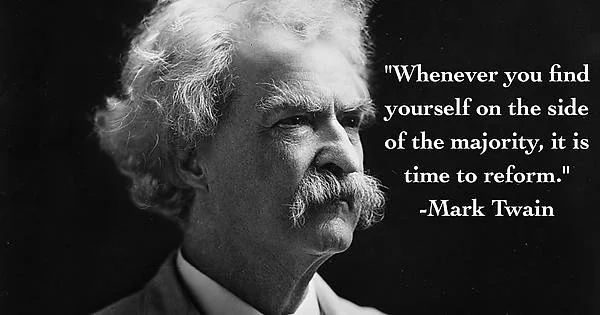
In expressing his hope that white Americans would do more to lift up former enslaved people and their offspring, he was in the minority of men of his time. Always a contrarian by nature, Mark Twain was not bothered by criticism of his belief in doing more to help oppressed people. In his later years, he went even further—speaking openly about the nation’s debt to Black Americans.
“We have ground the manhood out of them,” he wrote,
“and the shame is ours, not theirs, and we should pay for it.”
A Quiet Act of Defiance and Hope
 One of his most remarkable—and lesser-known—acts of conscience came near the end of his life, when he offered to quietly fund the education of a promising Black student named Warner T. McGuinn at Yale Law School. Twain believed that talent and character should never be blocked by race or financial hardship.
“I do not believe I would very cheerfully help a white student who would ask a benevolence of a stranger,” he wrote, “but I do not feel so about your case.”
McGuinn’s Legacy: Law and Mentorship
McGuinn graduated from Yale and became a respected civil rights attorney in Baltimore. There, he fought against racial discrimination and voter suppression. But perhaps his greatest legacy was his mentorship of a brilliant young man named Thurgood Marshall.
Thurgood Marshall: Carrying the Torch
 Inspired and encouraged by McGuinn, Thurgood Marshall became one of the most influential civil rights lawyers in American history. As head of the NAACP Legal Defense Fund, Marshall argued—and won—Brown v. Board of Education, the landmark 1954 Supreme Court case that struck down school segregation. Marshall consistently referenced the mentorship he’d received. While it’s unlikely that he knew that Mark Twain was part of the legacy that led him to the height of the legal profession, I have no doubt he’d appreciate it.
Marshall later became the first African American Justice of the United States Supreme Court.
The Takeaway: Ripples Through Time
Sometimes justice takes generations.
Mark Twain never completely outgrew, his racist, upbringing, and, of course, he never met Thurgood Marshall. But through his support of Warner McGuinn, he helped launch a quiet chain of influence that would help reshape America. A man who once wore Confederate gray became an unlikely ally of justice—and helped set in motion one of the most significant civil rights victories of the 20th century.
History often moves because of small, brave acts. And sometimes, its heroes come from the most unexpected places.


Fascinating!
Great story, Thank you