

What is a genius? Albert Einstein is an easy answer. But what about Sid Caesar? When we hear the word genius, we tend to think of equations, advanced degrees, and Nobel Prizes. 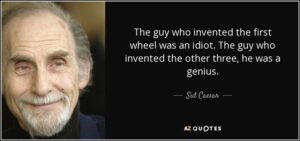 Yet true genius is rarely confined to the classroom—and it has a remarkable way of recognizing its own kind across entirely different fields. Born in Yonkers, New York, Caesar never attended college, but he possessed an innate, almost mathematical understanding of human behavior, timing, and rhythm. As a boy, he was so quiet that his family called him “Silent Sidney”—a child who barely spoke because he was too busy observing. When he grew up and stepped onto a television stage, that silence became an unmatched mastery of physical comedy. Caesar could dissect the human condition with a single grunt, a facial contortion, or a brilliant burst of gibberish double-talk. He was an intuitive genius of human emotion.
That brilliance did not go unnoticed by one of the finest minds of the twentieth century. In 1955, at the height of Caesar’s television fame, a telephone call came into his chaotic rehearsal studio. The caller was Albert Einstein’s secretary, contacting Caesar from Princeton to arrange a meeting between the two men. Caesar was certain that one of his writers was playing an elaborate prank. With another live broadcast approaching and an enormous amount of work still to be done, he had no time for jokes. But the call was genuine. Albert Einstein—perhaps the most famous scientist in the world—wanted to meet Sid Caesar.
The Two Professors – SId Caesar and Albert Einstein
Once Caesar became convinced that the invitation was real, his disbelief turned into a mixture of excitement and terror. What could a comedian possibly say to Albert Einstein? Caesar instructed his secretary to find every book she could on the theory of relativity so that he could prepare himself. He spent the weekend studying, even though he had already read about Einstein’s work. The irony is wonderful: Caesar had fearlessly played a 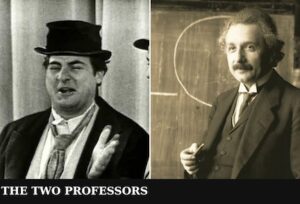 succession of absurd German professors on television, dazzling audiences with authoritative-sounding nonsense. Now the “professor” who knew absolutely nothing was preparing to meet the professor who seemed to know absolutely everything.
Before the meeting could be arranged, Einstein died on April 18, 1955. Caesar was left wondering why the great scientist had wanted to see him. Years later, after Caesar delivered a lecture at Columbia University, a tall, thin man approached him and introduced himself as J. Robert Oppenheimer, the physicist who had directed the laboratory that developed the atomic bomb. Oppenheimer told Caesar that Einstein had admired his work and had spoken about him many times. As Caesar later told the story, Einstein had solved the equations governing the physical world but wanted Caesar’s thoughts about something equally mysterious: “the human equation.”
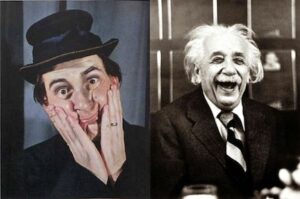 The two men never met, but perhaps the invitation itself tells us everything we need to know. Einstein explored the hidden laws of the universe; Caesar explored the equally baffling behavior of the human beings living within it. One expressed his discoveries through mathematics, the other through characters, pantomime, invented languages, and laughter. Their educations and careers could hardly have been more different, but both possessed an insatiable curiosity and an extraordinary ability to see things other people missed. Albert Einstein recognized in Sid Caesar what generations of comedians and writers would also recognize: genius sometimes knows genius when it sees it.