
Some of the cases that reached the Supreme Court challenge logic. For instance, during World War I, the Supreme Court was asked to decide if the military draft instituted by President Wilson was actually a violation of the 13th amendment that was the amendment that banned slavery!
While the 13th Amendment is very specific and clear in its absolute abolishment of slavery, the Supreme Court rarely hears cases that invoke it. But all of that changed during the First World War.
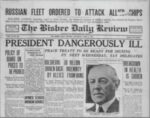
When the United States entered World War I in April 1917, President Woodrow Wilson faced an enormous problem. America had a relatively small army, but sending a major fighting force to Europe would require millions of men.
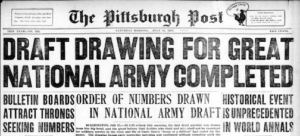 Congress responded by passing the Selective Service Act of 1917, requiring millions of American men to register for military service.
But was it constitutional for the government to force someone to serve?
Opponents challenged the law on several grounds. Their most provocative argument relied on the Thirteenth Amendment, ratified after the Civil War:
“Neither slavery nor involuntary servitude … shall exist within the United States.”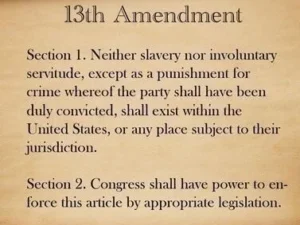
Their argument was straightforward. If the government could compel a man to perform a service against his will—and punish him if he refused—wasn’t that “involuntary servitude”?
The question reached the Supreme Court in a group of cases known as the Selective Draft Law Cases, decided in 1918.
The Court unanimously rejected the argument.
Chief Justice Edward Douglass White, himself a former Confederate soldier, wrote the decision. The Constitution specifically gives Congress the power to “raise and support Armies,” he explained, and the obligation of citizens to defend their country existed long before the Constitution.
The Thirteenth Amendment abolished slavery and compulsory labor resembling slavery. It did not eliminate the government’s power to require military service. In fact, the Court considered the argument so implausible that White suggested merely stating it was enough to refute it.
The draft survived.
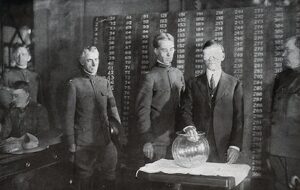 Nearly 24 million American men registered during World War I, and approximately 2.8 million were drafted. America would later use conscription during World War II, Korea, and Vietnam, when opposition to the draft became one of the defining controversies of the era.
The United States ended the draft in 1973 and moved to an all-volunteer military. However, most American men ages 18 through 25 are still required to register with the Selective Service System.
And the constitutional principle established more than a century ago remains:
The Thirteenth Amendment says the government cannot force you into involuntary servitude.
But military service, the Supreme Court decided, is something different.