

Quick question: Is a tomato a fruit or a vegetable?
If you answered “fruit,” congratulations—you agree with botanists. If you answered “vegetable,” congratulations—you agree with the United States Supreme Court!
Imagine you’re a justice on the United States Supreme Court. You expect to hear arguments about the Constitution, freedom of speech, or the powers of the President. Instead, it’s 1893, and the question before you is this: Is a tomato a fruit or a vegetable? Believe it or not, that was the issue in Nix v. Hedden, one of the Court’s most unusual cases.
Fruit or Vegetable? The Supreme Court Had to Decide
The dispute wasn’t really about botany—it was about taxes. A federal tariff required 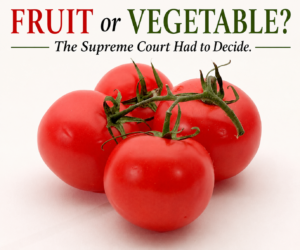 importers to pay a duty on vegetables, but not on fruits. Everyone agreed that botanically a tomato is a fruit because it develops from the flower of the plant.
However, customs officials classified tomatoes as vegetables because they were commonly served with dinner rather than dessert.
The Justices researched, debated, and gave deep thought to the question.
The Decision?
The Supreme Court unanimously agreed, ruling that in everyday language and commerce, tomatoes were vegetables, even if science said otherwise.
The tomato case is a wonderful reminder that the Supreme Court’s job isn’t always to answer life’s biggest philosophical questions. Sometimes it must settle surprisingly ordinary disputes that affect everyday Americans. More than 130 years later, Nix v. Hedden remains one of the Court’s most memorable decisions—and proof that even something as simple as a tomato can make legal history.